Showing posts with label human culture. Show all posts

Wrathful and Jealous

Depiction of hell, in the illuminated prayerbook, Très Riches Heures du duc de Berry, Folio 108, created between c. 1412 and 1416 by the Limbourg Brothers.Depiction of hell, in the illuminated prayerbook, Très Riches Heures du duc de Berry, Folio 108, created between c. 1412 and 1416 by the Limbourg Brothers.
How did we get to where we are today, facing environmental catastrophe, species extinction, conflict, hatred, division and destruction on a grand scale?

A critical factor has been the way that human spirituality has changed over time, moving from animism through polytheism and henotheism to monotheism.

In theological terms, the movement has been from “immanence” to “transcendence”, from integration to separation. Immanent spirituality in belief systems such as pantheism and animism is based on the recognition that Life, Spirit, sacredness is “in-dwelling”, permeating everything, everywhere. There’s only one world in animism and pantheism. There are no other-worldly domains, no heavens or hells, for the administration of rewards and punishments respectively.

By contrast, belief systems based on transcendence – such as the monotheistic religions – feature entities/gods that transcend Reality, standing above and apart from the world and everything in it.

In psychological terms, the movement has been from a recognition of feminine and masculine on an equal footing towards a misogynistic psychology in which masculine characteristics predominate.

In cultural terms, the movement has been from nomadic hunter/gatherer societies towards more settled societies based initially on agriculture and subsequently on industry and commerce. In hunter/gatherer cultures, the focus is on avoiding waste. In agricultural/industrial cultures, the focus is on producing a surplus.

footlong and fancy-free: why size doesn't matter

Joule's apparatus for measuring the mechanical equivalent of heat energy. A descending weight attached to a string causes a paddle immersed in water to rotate. Caption by Wikipedia, 6 May 2014Joule's apparatus for measuring the mechanical equivalent of heat energy. A descending weight attached to a string causes a paddle immersed in water to rotate. Caption by Wikipedia, 6 May 2014.
No energy? No matter!

Zero, zip, nada, none: that's how much is left after you turn matter into energy, via a bomb or a power station. But what kind of power station is best? It's actually impossible to say.

I’ve heard that coal-fired power stations are dirty, wind-farms are ugly, and nuclear power stations are dangerous (but much more efficient at producing energy).

Do you agree? I don’t, and I’ll provide the supporting logic in a minute. But first let’s unpack the conventional wisdom and hold it up to the light until it withers and dies!

Power stations are designed to transform matter into energy, or one form of energy into another. If you’ve got nothing better to do, you can use Einstein’s equation, E=MC2, to work out the energy equivalent of the mass1 of any given chunk of matter. The equation says that energy (E) equals mass (M) multiplied by the speed of light (C) squared.

I’ve heard that the reason why you get so much energy via nuclear processes2 is that the speed of light (squared) is such a big number. Really?

Ode to My Job

'Arbeit macht frei' is a German phrase meaning 'Work shall set you free' found above the entrances to a number of Nazi concentration camps during World War II. More than 70 years later, almost everyone is an inmate of the global concentration camp of modern human culture. Work doesn't make us free, it enslaves us.    A person at work is a person with no identity. Ze is not a person, just a uniform, a suit. A person at work has no mind of zer own, no brains, no head. As the painting suggests, the body of a person at work ends at the neck.
   
The corporatisation of human life and culture proceeds at an accelerating rate. One of the results is the destruction of our humanity itself. Another is the destruction of the planet.
   
A person at work is a psychopath with no personal values, just a fake but hearty enthusiasm for the values of the corporation. Every morning, when we walk into the workplace, we leave our personal values at the door. We're all psychopaths, these days, or sociopaths if you're into labels. We repress and suppress our personhood, our empathy, at the behest of the employer. That's why there are cruel red eyes in the lapels of a pin-striped suit. They are the insane eyes of one who has lost zer personhood.
   
And yet, as Jesus is said to have said, . 'Arbeit macht frei' is a German phrase meaning 'Work shall set you free' found above the entrances to a number of Nazi concentration camps during World War II. More than 70 years later, almost everyone is an inmate of the global concentration camp of modern human culture.

Work doesn't make us free, it enslaves us. A person at work is a person with no identity. Ze is not a person, just a uniform, a suit. A person at work has no mind of zer own, no brains, no head. As the painting suggests, the body of a person at work ends at the neck.

The corporatisation of human life and culture proceeds at an accelerating rate. One of the results is the destruction of our humanity itself. Another is the destruction of the planet.

A person at work is a psychopath with no personal values, just a fake but hearty enthusiasm for the values of the corporation. Every morning, when we walk into the workplace, we leave our personal values at the door. We're all psychopaths, these days, or sociopaths if you're into labels. We repress and suppress our personhood, our empathy, at the behest of the employer. That's why there are cruel red eyes in the lapels of a pin-striped suit. They are the insane eyes of one who has lost zer personhood.

And yet, as Jesus is said to have said, "Consider the lilies of the field, how they grow; they toil not, neither do they spin. And yet I say unto you, That even Solomon in all his glory was not arrayed like one of these."

And here we are, 2000 years later, toiling and spinning for dear life, and not liking it very much at all.

Painting by SRS, oils on board, 54.5 x 74.5 cm.

No agenda was tabled
No meeting was chaired
All came who were abled
No-one was spared.

No minutes were red
The suits were all blue
All heard what was said
About what they should do.

No actions were listed
As open or closed
No task-owners queried
No deadlines imposed.

The guest speaker rose
He got to his feet
Assumed a cool pose
Said “Hi there, I’m Pete!”

That’s what he said
When he got up to speak
No hat on his head
At the meeting that week.

So why was he there
At the Monday team meeting?
Dark suit and great hair
Fake warmth in his greeting?

And what did he say
That well-groomed consultant
On that awful day
What was the resultant?

"Your boss couldn’t be here
He was feeling quite tired
But He asked me to tell you
You’re gone, you’re all fired!

"Not moved or suspended
And not redeployed.
We recommended
Now you’re unemployed."

For those who ...

... CONTINUES in ... AWAREWOLF & Other Crhymes Against Humanity for kindle, tablet, smartphone or e-reader.

HOME

eBooks by Cosmic Rapture
(for kindle, tablet, smartphone or e-reader.)

NIGHTMERRIES: THE LIGHTER SIDE OF DARKNESS. This so-called "book" will chew you up, spit you out, and leave you twitching and frothing on the carpet. More than 60 dark and feculent fictions (read ‘em and weep) copiously and grotesquely illustrated.

AWAREWOLF & OTHER CRHYMES AGAINST HUMANITY (Vot could be Verse?). We all hate poetry, right? But we might make an exception for this sick and twisted stuff. This devil's banquet of adults-only offal features more than 50 satanic sonnets, vitriolic verses and odious odes.

MANIC MEMES & OTHER MINDSPACE INVADERS. A disturbing repository of quirky quotes, sayings, proverbs, maxims, ponderances, adages and aphorisms. This menagerie holds no fewer than 184 memes from eight meme-species perfectly adapted to their respective environments.

MASTRESS & OTHER TWISTED TAILS. An unholy corpus of oddities, strangelings, bizarritudes and peculiaritisms, including but not limited to barbaric episodes of herring-flinging and kipper-kissing. A cacklingly bizarre read that may induce fatal hysteria. Not Recommended!

FIENDS & FREAKS and serpents, dragons, devils, lobsters, anguished spirits, hungry ghosts, hell-beings, zombies, organ-grinders, anti-gods, gods and other horse-thieves you wouldn't want to meet in a dark cosmos. Immature Content! Adults Maybe.

HAGS TO HAGGIS. An obnoxious folio featuring a puke of whiskey-soaked war-nags, witches, maniacs, manticores and escapegoats. Not to mention (please don't!) debottlenecking and desilofication, illustrated. Take your brain for a walk on the wild side. Leave your guts behind.

Dreamtime: the De-flattening (wild turkey dreaming)

Supposedly the biggest monolithic rock on the planet, Supposedly the biggest monolithic rock on the planet, "Uluru, ... also known as Ayers Rock ... is a large sandstone rock formation in ... central Australia. ... Kata Tjuta, also called Mount Olga or the Olgas, lies 25 km (16 mi) west of Uluru." (Wikipedia, 2 Dec. 2016)
Animation combines photograph of Uluru by Mark Gray (markgray dot com dot au) and bark painting of rainbow serpent by John Mawurndjul.
In the Dreamtime before time and space the Great Serpent Koniara slithered and thrashed mightily, creating the Land of Oz, the Sky above, and the Sea that washed its shores. And when his mighty slithering was done, Koniara called a great Corroboree to honour his creation.

Among those who came to the Corroboree was the scaly crocodile, Gumungung, who spake unto Koniara, saying, “O Great One, what thee or thou have wrought is awesome and immense, but there is no colour, no excitement, no magic or joy in the Land. As far as the eye can see, all is red and brown and flat as a toenail. And that’s more dull and boring than a pub with no beer. And newsflash: it’s also way too frickin’ hot!”

“My sacred doings be not to thy satisfaction,” quoth Koniara unto Gumungung, “and yet I made the whole ball of wax in just two days not six, and I didn’t need to chuck a sickie on the seventh neither.”

“More elbow grease maybe, that might have helped,” quoth Kuruku the Kookaburra, whose laughter rang out long and loud in the dry and beerless air.

The Gospel of Scissors Paper Rock

animation to illustrate scissors paper rock, by SRS/CR/MMIn Japan, Mushi-ken is one of the earliest rock-paper-scissor or sansukumi-ken games. Published in the Kensarae sumai zue by Yoshinami and Gojaku. From left to right: Slug (蚰蜒 namekuji), frog (蛙 kawazu), and snake (蛇 hebi). The frog defeats the slug, the slug defeats the snake, and the snake defeats the frog. (Wikipedia 26 Nov. 2016)
Rock blunts scissors
The massive dead stone of ignorance and superstition blunts and smashes the keen sharp mind seeking truth.

Scissors cuts paper
The mind that is too keen and too sharp cuts the paper on which truth is written into disconnected shreds of reductionism and limited perspective.

Paper wraps rock
With lightness and breadth, truth enfolds and conceals the massive dead stone of ignorance and superstition.

Published in MANIC MEMES & OTHER MINDSPACE INVADERS, a disturbing repository of quirky quotes, sayings, proverbs, maxims, ponderances, adages and aphorisms. This menagerie holds no fewer than 184 memes from eight meme-species perfectly adapted to their respective environments. for kindle, tablet, smartphone or e-reader.

Do you believe in mermaids?

A Mermaid by John William Waterhouse (1849–1917), oil on canvas'A Mermaid' by John William Waterhouse
(1849–1917), oil on canvas
Do you believe in mermaids?
in werewolves dark and furry?
in banshees, beasties, pointy pixies,
ghosts who go all blurry?

Do you believe in unicorns?
in vampires tall and smiling?
in witches, wizards, druids’ blizzards,
wood-nymphs so beguiling?

Are you in fact an alien?
a monster green and pimply?
a freak, a fright, a barrow-wight,
a corpse whose limbs lie limply?

If so then go to meet your friends
across the cold black river
perhaps they’ll kiss your bloodless lips
or ...

CONTINUES in ... AWAREWOLF & OTHER CRHYMES AGAINST HUMANITY (Vot could be Verse?) for kindle, tablet, smartphone or e-reader.

HOME

eBooks by Cosmic Rapture
(for kindle, tablet, smartphone or e-reader.)

NIGHTMERRIES: THE LIGHTER SIDE OF DARKNESS. This so-called "book" will chew you up, spit you out, and leave you twitching and frothing on the carpet. More than 60 dark and feculent fictions (read ‘em and weep) copiously and grotesquely illustrated.

AWAREWOLF & OTHER CRHYMES AGAINST HUMANITY (Vot could be Verse?). We all hate poetry, right? But we might make an exception for this sick and twisted stuff. This devil's banquet of adults-only offal features more than 50 satanic sonnets, vitriolic verses and odious odes.

MANIC MEMES & OTHER MINDSPACE INVADERS. A disturbing repository of quirky quotes, sayings, proverbs, maxims, ponderances, adages and aphorisms. This menagerie holds no fewer than 184 memes from eight meme-species perfectly adapted to their respective environments.

MASTRESS & OTHER TWISTED TAILS. An unholy corpus of oddities, strangelings, bizarritudes and peculiaritisms, including but not limited to barbaric episodes of herring-flinging and kipper-kissing. A cacklingly bizarre read that may induce fatal hysteria. Not Recommended!

FIENDS & FREAKS and serpents, dragons, devils, lobsters, anguished spirits, hungry ghosts, hell-beings, zombies, organ-grinders, anti-gods, gods and other horse-thieves you wouldn't want to meet in a dark cosmos. Immature Content! Adults Maybe.

HAGS TO HAGGIS. An obnoxious folio featuring a puke of whiskey-soaked war-nags, witches, maniacs, manticores and escapegoats. Not to mention (please don't!) debottlenecking and desilofication, illustrated. Take your brain for a walk on the wild side. Leave your guts behind.

Power-dressing in the Psychopathic Workplace

Arbeit Macht Frei, by CR/MM/SRS, oils on board, commenced 2005 finished 2014, 54.5 x 74.5 cm"Arbeit macht frei" is a German phrase meaning "Work shall set you free" found above the entrances to a number of Nazi concentration camps during World War II. More than 70 years later, almost everyone is an inmate of the global concentration camp of modern human culture. And yet, as Jesus is said to have said, "Consider the lilies of the field, how they grow; they toil not, neither do they spin. And yet I say unto you, That even Solomon in all his glory was not arrayed like one of these."
The wearing of neckties, by men, at work, is a cultural practice akin to the chest-thumping dominance displays of jungle gorillas. There is a fabric-based language, a symbology, a semiotics used in the workplace, where necktie-encoded subliminal messages about power, position and personality are constantly being transmitted and received. The dialect of necktie-wearing stems from the language of corporate power-dressing, which is more about psychopathy than about style or fashion.

And yet, and yet and yet. In the context of self-actualisation and personal growth, attention to physical appearance and accoutrement such as clothing is considered to be counter-productive, at least within some discourses). There's a highly potent meme infecting the minds of many internet-users, that the more you think about how you look, the less progress you make on your spiritual journey. Ghandi for instance was never friendly with Calvin Klein: the one died before the other was even born. Nor would the Buddha have given much thought to the style or fabric of his loincloth.

And yet, and yet, and yet. Isn't it true to say that the discourse in which a higher value is placed on becoming self-actualized than on enjoying a good meal or a good fuck, say, is itself context-dependent and relative? And therefore, in some contexts, for some people, the pursuit of spirituality is just as 'stupid' or 'meaningless' as the wearing of neckties in the workplace.

[Digression alert: the quantity of dried snot and sperm on the doors and walls of workplace toilets is an indicator of the extent to which work in that workplace is seen as stupid or meaningless. Body fluids are an effective medium in which to express messages about despair and desperation.]

Which leaves us washed up high and dry on the drear shores of meaninglessness, enslaved by our own choices and contexts, and self-deceived by the trickster going by the name of Free Will.

But there is a way out. And it's really very simple. Here`s the way out: don't be surprised by the outcomes of your choices and don't complain about them. Or do complain, but then don't complain when your complaint fails to achieve the outcome/s you seek. Because you become a serial whinge-bag and acquire a taste for it, and then pity everyone around you.

HOME

Enlightenment: the Dark Side

Depiction of the Wheel of Existence, showing the six realms of existence, with Lord Yama the "God" of Death in attendance. Applique and embroidery on silk. (circa 1800)

The Question

Abiding in bliss sounds great, but wouldn't it get boring after a while? Why seek to achieve enlightenment and/or nirvana and become One with the All?

From various sources, including conversations with various people (some real), I've constructed a ramshackle, unstable, incomplete and misleading picture of what some aspects of enlightenment/nirvana mean, to some people.

But I don't understand what the benefits are; I don't understand why achieving enlightenment should be set as a goal.

According to some schools of Buddhist thought, life is full of pain and misery. Then you die and are reborn... into another life of pain and suffering... over and over again, until you escape Samsara (the "Wheel of Cyclic Existence"), achieve nirvana and become One with the All.

Reincarnation is to be avoided. Life is to be avoided. The self must be liberated from the endless wheel of cyclic existence.

Or so they say. But is that true for everyone?

Not every life is full of pain and suffering. Life may be full of delusion, but what's so terrible about a bit of delusion once in a while? And even if every single life, without exception, is nothing but pain and suffering and delusion and aversion, some might still prefer that over nothingness, blissful or otherwise.

Us vs Them

Penguin Classics Deluxe Edition, first published in Britain 2005, with introductory comments from the Dalai Lama.
What is a person? It's an important question because the way that a human behaves towards another lifeform is determined by whether the human believes the other lifeform to be a person or not.

In the introductory commentary to the Penguin Classics Deluxe Edition (2005) of the Tibetan Book of the Dead, the Dalai Lama describes the Tibetan Buddhist view of what constitutes a person, as set out below.

"Among the ancient schools of thought, which accepted the notion of continuity of consciousness, there were several non-Buddhist philosophical schools which regarded the entity, the 'I' or 'self', which migrated from existence to existence as being unitary and permanent. They also suggested that this 'self' was autonomous in its relationship to the psycho-physical components that constitute a person. In other words they believed or posited that there is an essence or 'soul' of the person, which exists independently from the body and mind of the person.

We are all strange loops

Strange Loop -- book cover
In “I am a strange loop” (2007) Douglas Hofstadter proposes that the self -- personal consciousness -- is a pattern. Hofstadter notes that patterns exist at different levels of resolution, ie at different points on a spectrum of granularity, from coarse-grained to fine-grained.

Here’s an example: Jack and Jill are persons who know each other. Per Hofstadter’s idea, the knowledge of Jill in Jack’s mind is as much a valid part of Jill as Jill's physical body is part of Jill. But the knowledge of Jill in Jack’s mind is “low res.” compared with the knowledge of Jill in her own mind. Jill’s actual body and mind are at the highest res available.

Extending the idea: A photograph of Jill is part of Jill. And so too are letters written by Jill, letters written about Jill, clothes worn by Jill, memories of Jill in the minds of her friends: these are all parts of Jill. Every part and aspect of reality touched by Jill in any way, is part of Jill — the “Greater Jill”, the total, aggregated footprint of Jill upon Reality.

Perhaps the most significant difference between the various parts or aspects of Jill is the extent to which each is subject to change. Everything is subject to change, but some things change less than others. A digitized photograph of Jill uploaded to the internet is less subject to change than Jill’s physical body.

How eating dogshit can avert death

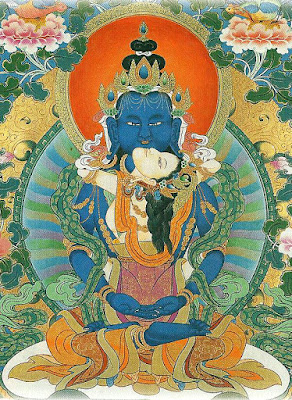
The male and female primordial buddhas Samantabhandra and Samantabhadri in union. Thangkas painted by Shawu Tsering and photographed by Jill Morley Smith are in the private collection of Gyurme Dorje.The male and female primordial buddhas Samantabhandra and Samantabhadri in union. Thangkas painted by Shawu Tsering and photographed by Jill Morley Smith are in the private collection of Gyurme Dorje.
If we were sitting on a mountaintop with the wind in our hair and the stars in our eyes and a mug of yak-buttered tea in our hands, maybe just maybe we could have a productive conversation about the Book.

I'm talking about The Tibetan Book of the Dead, deluxe edition, with introduction by the Dalai Lama, Penguin Books Ltd, 2005.

Much of the material is outrageously bizarre and peculiar (in my eyes, at the time of reading). For example, here's an excerpt from the Specific Rites for Averting Death:

“When the indication of protruding ankle bones appears, one should face westward towards the sun when it is close to setting and remove one's clothes. Then, placing a dog's tail under oneself, and some dog excrement in a heap in front, one should eat a mouthful and bark like a dog. This should be repeated three times...

“Also in cases where other people are afflicted by illness: if the roots of their teeth grow grimy and black, such a person should wear a goat's skin, face the sunrise, and bleat three times like a goat. Similarly, in cases where the nostrils sag inwards, it will be beneficial if one visualises the syllable A on the tip of the subject's nose, recites the syllable A twenty-one times, and bathes in various rivers...” (Number of rivers not specified.)

Enlightenment? Or a Cold Beer Instead?

MAYA, MIRROR OF ILLUSIONS by A.B. Davies
What is this thing called "enlightenment" and why would one want it?

I've got nothing against the concept: I just want to know what the specific benefits are. As it says in the poem in the previous post (below): One wonders why oneness is set as a goal.

Unfortunately, there's not much hard info on the benefits of enlightenment, nor on what it is exactly or how it manifests or how to achieve it. It's one of those slippery words/concepts, like "God", that can mean many things to many people. Conveniently though, we can identify a small number of broad themes to help make sense of all the detail.

Enlightenment is believed to involve:

  • escaping the endless cycle of reincarnation -- the recurring samsara of birth, death, rebirth -- in which every soul is believed to be trapped
  • quantum entanglement in the biological sense, ie being "at one" with all living things
  • getting closer to God (I don't know what "closer" or what "God" means; but some people do, apparently)
  • absence of personal identity, or the state in which one finds oneself after losing oneself
  • living outside of time / "living in the now", a technique believed to lighten the (alleged) psychological burden of regrets about the past and anxieties about the future
  • accessing lost or secret knowledge about how things really work, and our individual roles in the process
  • seeing through the illusion, the maya, of a time-bound, material world in which everything is relative to every other thing, and nothing stands still long enough to be real.

They don't bleed when you cut them

Economic power is concentrated in the hands of a few giant multi-national corporations. Apologies for no attribution but I can't remember where I found this diagram.
It's a strange world, and getting stranger by the minute. If you're not part of the solution you're part of the problem.

I don't know what the solution is, but we all know what the problems are. And if people of goodwill and strong will put their heads and hearts and hands together, we can help steer the doomed Titanic of human culture out of the path of the iceberg of human greed and selfishness.

IMHO many of the problems are the direct result of the actions of large corporations, especially 'multi-nationals’.

I think the following two actions would help address many of the problems we face (and have caused). To implement either or both will be very difficult, but game-changing if done successfully.

  1. Remove the protection corporations enjoy as 'legal persons'. A legal person can “…sue and be sued, enter contracts, incur debt, and own property” (Wikipedia 22 July 2016).
  2. Remove the protection of limited liability for shareholders, partners and directors. Under limited liability, “a person's financial liability is limited to a fixed sum, most commonly the value of a person's investment in a company or partnership” (Wikipedia 22 July 2016).

It's not a god-given right of a corporation to be treated as a legal person. No, in fact the opposite. It's a get-out-of-jail-free card that flesh-and-blood people gave to corporations roughly three hundred years ago. Legal personhood enables corporations to enjoy the benefits of being a flesh-and-blood person, with few of the responsibilities or accountabilities.

The Assembly of Peaceful and Wrathful Deities

The male buddha Vairocana in union with the female buddha Akasadhatvisvari. Thangkas painted by Shawu Tsering and photographed by Jill Morley Smith are in the private collection of Gyurme Dorje.The male buddha Vairocana in union with the female buddha Akasadhatvisvari.
This post is about the so-called "peaceful and wrathful deities" in The Tibetan Book of the Dead (deluxe edition, Penguin, 2005).

Here's a crude summary: when you're dead, initially you may encounter things that may seem to be deities but which are really just products of the mind/imagination.

According to the Book (p 387), the deities are symbols that emerge from:

the meditator's own awareness ... and sensory and mental processes.

The 42 symbols of peacefulness:

represent the quiescent natural purity of these fundamental components of our being.

Up close and personal

This image features the head of an extra-terrestrial lifeform superimposed on 'Vitruvian Man', a drawing by Leonardo da Vinci (1452–1519)This image features the head of an extra-terrestrial lifeform superimposed on 'Vitruvian Man', a drawing by Leonardo da Vinci (1452–1519)
The nature of interactions between persons is determined by the extent to which one person believes another is a person.

In the apartheid years in South Africa, for example, the Dutch Reformed Church rationalised the harsh treatment of black people (“non-whites”) on the basis that they have no souls, do not qualify for salvation, and therefore should not be treated as persons. This twisted logic was frequently included by Dutch Reformed Church ministers in their Sunday sermons to the volk.

Slavery is another example. As the property of the slave-owner, slaves were (and in some places still are) used, abused, bought, sold, burnt, broken and disposed of as if they were pieces of furniture. Clearly, a slave is not a person in the eyes of the slave-owner.

Dictionary.com lists a number of different meanings of “person” including “…a human being as distinguished from an animal or a thing.” “Person” can also mean “a self-conscious or rational being (in the philosophical sense)”, or “a group of human beings, a corporation, a partnership, an estate, or other legal entity (artificial person or juristic person) recognized by law as having rights and duties.”

So an animal can never be a person, according to at least one dictionary. Of course, the Indian government would disagree, having declared dolphins to be non-human persons.

There are many different definitions of “person” but they all belong under either (but not both) of the following two headings:

  • Every person is a human.
  • Every human is a person.

On the outside

Pacing the icy hallways and crystal corridors of the Fortress of Solitude, Superman pondered the meaning and purpose of his life. Frozen tears sparkled on his super-cheeks, for the steel-trap mind of the man of steel was corroded and tarnished with self-pity.

Alone. Sad. Tired. He ventured forth seldom those days into so-called civilisation. Alienated and profoundly depressed, he no longer sought to wreak justice upon the wrongdoer. Apparently indifferent to the plight of the undefended innocent, seemingly unaware of the cataclysmic disasters besetting a helpless world, the superhero disgruntedly trundled the polar passages, ruminating on the ingratitude of those for whom he had laboured long and mightily to protect.

And for what? The people of Earth had never been overly generous towards their saviours. Crucifixion for example seemed about as rewarding as a jab to the eye with a sharp piece of kryptonite. Which was why he'd been forced to keep his true identity a secret.

Resentment and bitterness permeated his super-soul. He felt used, dirty, discarded. Well, he would show them. No longer would he hide behind mild-mannered reporters. He would openly express his pride. He would come clean.

He would wear his underpants on the outside.

HOME

A sermon on vermin

MEDEA, lithograph by Alfons Mucha (1860–1939). At the feet of the sorceress are her children, whom she has murdered to spite her ex-lover Jason (he of the golden fleece!)
With a slap of your hand you kill the mosquito that alights on you for a quick meal. With a stomp of your foot you squash dead a cockroach too slow at scurrying away. With a deadly feather-duster or vacuum cleaner you destroy the spiders and their elegant webs painstakingly woven in the nooks and crannies of your home. For no good reason other than to test the speed of your reflexes, you grab and clutch to death a tiny, inoffensive midge flying through the air. With an ozone-friendly insecticide you murder dozens of ants clearing away the debris on your kitchen floor. Humming a merry tune, you place a deadly mousetrap in your pantry cupboard.

You think of yourself as a person with at least one foot on the path to enlightenment. You rationalise the killing as being acceptable considering the nature and insignificance of the victims.

Yet the cockroach is to you as you are to the sentient entity known as Everything, aka Reality. The ant knows you as well as you know Everything. The mouse in the mousetrap understands its agony as well as you understand the trials and tribulations that Reality inflicts upon you. Do you want Everything to treat you as you treat those you believe are “lower” forms of life?

Actually, the sentient entity known as Reality doesn’t always treat humans in ways that humans would describe as “gentle” or “loving” or “respectful”. Let’s not forget that every thing is as much a part of Everything as anything, which is why Everything treats every thing equally. The so-called “acts of Everything”, including droughts, hurricanes, tsunamis and earthquakes, continue to cause misery and death to humans, cockroaches, ants and mice indiscriminately.

What makes humans a “higher” form of life than, say, mice? It’s true that mice don’t build cathedrals as well as humans do. But humans don’t scurry or gnaw or reproduce as well as mice do. In what way is cathedral-building a worthier activity than gnawing, or reproducing for that matter?

Global warming's habit-forming

DetailDetail from Hungry Ghosts Scroll, late 12th century, Kyoto National Museum, Japan. You don't have to be Buddhist (or even human) to feel that life is pain and misery. But some lives are more painful and miserable than others. One of six lifeforms available to humans for reincarnation purposes, hungry ghosts (aka anguished spirits) can never satisfy their monstrous appetites.
If humans were to go away
Would nice terrestrials stay and play?

Were we to leave for outer space
Who'd stand and say we're in disgrace?

Fish don't know its paradoxic
Waste is food and food is toxic

No birds there be, or bees, or trees
Who realize we spread disease

We'd like to say with deep remorse
We're very sorry, yes of course

But where's the mailbox on the moon
To send the Earth a Get-Well-Soon?

To tenderize a tough old bird
Just cook her longer, so I’ve heard

But like revenge, or so I’m told
The Earth is better eaten cold.

HOME

As below, so above

According to Heisenberg's uncertainty principle, the respective values of certain pairs of physical properties---such as position and momentum, or time and energy---cannot both be known simultaneously. The more precisely one property is known, the less precisely the other is known. For example, the more certain you are about the position of a sub-atomic particle, the less certain you are about its momentum.

The uncertainty has nothing to do with the inadequacy of measuring instruments, but rather is a fundamental property of Reality: when some things are known, other things can’t be known at the same time.

“So what?” I hear you say, “Who cares about where a sub-atomic particle is at? What’s that got to do with the real world?”